
Diesel Turbocharger Guide: VGT Diagnosis, Rebuild & Replacement
How We Tested and Verified
Turbocharger specifications, boost pressure targets, and VGT actuator calibration procedures verified against Holset Service Manual (HE351VE/HE431VE), Garrett Technical Bulletin GTB1756VK, and BorgWarner K-Series service data. Shaft play tolerances and oil feed pressure requirements cross-referenced with Cummins QuickServe and Ford WSM Section 303. Cost data from 150+ turbo rebuild and replacement jobs on pickup and Class 8 platforms.
This content is for informational purposes only. Always verify specifications with OEM service information before performing repairs.
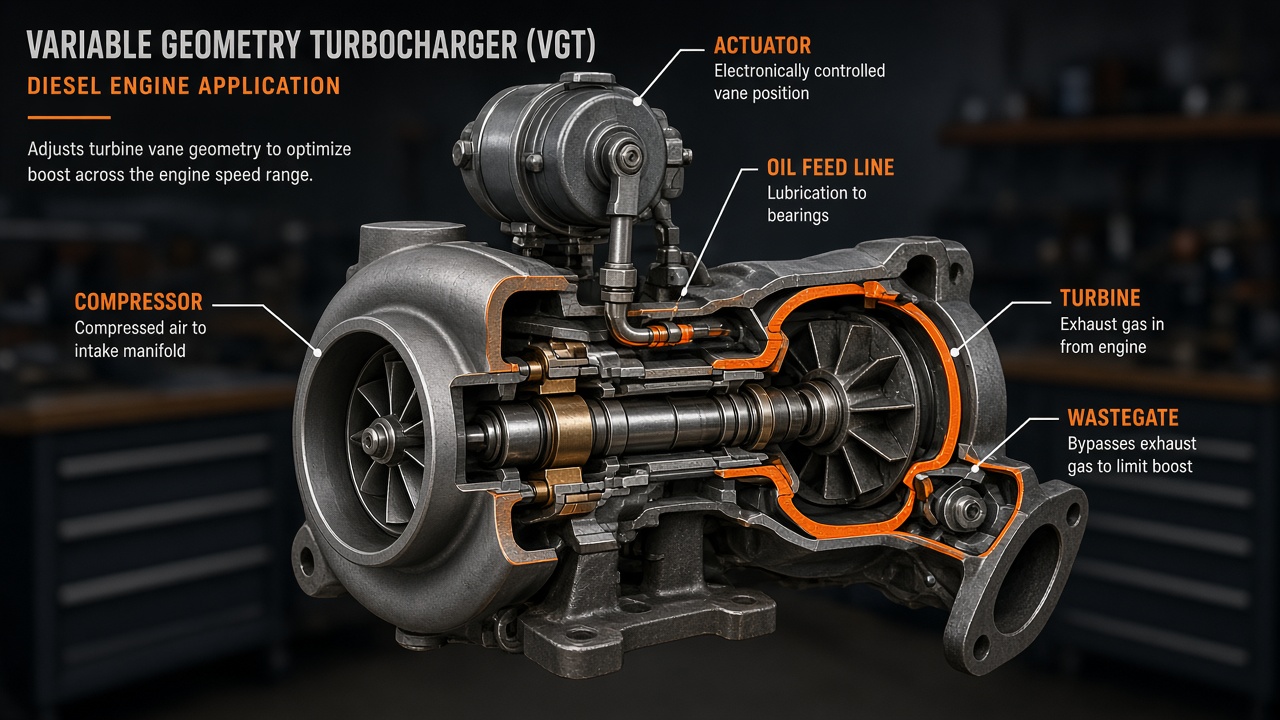
A diesel VGT turbo produces platform-specific boost at WOT—32–35 psi on 6.7L Cummins, 28–32 psi on 6.7L Power Stroke and L5P Duramax—and the ECM commands vane position from 80–95% closed at idle to 10–25% open at WOT. Low boost with command/actual deviation over 10% usually traces to boost leaks (15-psi charge-air test), stuck vanes, or a failed actuator before condemning the turbo. Shaft axial play above 0.015” or radial play above 0.015” requires rebuild or replacement. Oil in intercooler pipes indicates compressor seal failure.
Safety: Never start an engine with a dry turbo—prime the oil feed line by cranking with fuel disabled until oil flows, then idle 3 minutes before load. Hot center cartridges cook oil if you shut down immediately after highway driving; allow a 3-minute cooldown idle.
How Diesel Turbochargers Work
Fixed Geometry vs. Variable Geometry
Fixed geometry turbos (HX35, HX40, GT3782) use a fixed turbine housing size. Boost is controlled by a wastegate that bypasses exhaust around the turbine wheel above a set pressure. Common on pre-2007 engines and industrial applications.
Variable geometry turbos (VGT) use movable vanes in the turbine housing that change the effective exhaust flow area. At low RPM, vanes close to speed up exhaust velocity and spool the turbo quickly. At high RPM, vanes open to prevent overboost. VGT is standard on every 2007+ pickup diesel and 2010+ HD engine.
Key Components
| Component | Function | Failure Mode |
|---|---|---|
| Compressor wheel | Draws and compresses intake air | FOD damage, erosion from dust |
| Turbine wheel | Driven by exhaust gas energy | Cracking from EGT spikes |
| Center cartridge (CHRA) | Houses shaft, bearings, oil passages | Bearing wear, oil seal failure |
| VGT actuator | Moves turbine vanes via vacuum or electric motor | Stuck vanes, failed motor/solenoid |
| Wastegate (fixed geo only) | Limits maximum boost | Stuck open (no boost) or closed (overboost) |
Boost Pressure Specifications
Pickup Platforms
| Engine | Turbo Model | Idle Boost | Cruise Boost | WOT Boost | Overboost Limit |
|---|---|---|---|---|---|
| 6.7L Cummins (2013+) | Holset HE351VE | 0-3 psi | 18-24 psi | 32-35 psi | 42 psi |
| 6.7L Power Stroke | Garrett GT3782VA | 0-2 psi | 16-22 psi | 28-32 psi | 38 psi |
| L5P Duramax | Garrett GT3582R | 0-2 psi | 18-24 psi | 28-32 psi | 38 psi |
| 6.7L Cummins (2007-2012) | Holset HE351VE | 0-3 psi | 16-22 psi | 30-33 psi | 40 psi |
Heavy-Duty Platforms
| Engine | Turbo Model | Cruise Boost | Peak Boost | Rated HP |
|---|---|---|---|---|
| Cummins ISX15 | Holset X113 | 22-28 psi | 35-40 psi | 400-605 HP |
| Detroit DD15 | BorgWarner K27 | 24-30 psi | 38-42 psi | 400-505 HP |
| PACCAR MX-13 | Holset MHE | 22-28 psi | 35-38 psi | 400-510 HP |
| Cummins X15 | Holset X152 | 24-32 psi | 40-45 psi | 400-605 HP |
Log boost pressure with a scan tool during a loaded road test. Compare actual to expected at each RPM point. Deviation of more than 5 psi indicates a problem.
EGT and Boost Correlation
Post-turbo EGT and boost pressure should rise together under load. Useful correlations:
| Condition | Boost | EGT | Likely Cause |
|---|---|---|---|
| Low boost, normal EGT | Low | Normal | Charge-air leak, stuck-open VGT |
| Low boost, high EGT | Low | High | Exhaust restriction (DPF), turbine damage |
| High boost, high EGT | High | High | Overfueling, leaking injectors |
| Normal boost, high EGT | Normal | High | Retarded timing, failed regen enrichment |
Log boost and EGT on the same pull. A 10-psi boost drop with 200°F EGT rise at identical RPM points to downstream restriction before condemning the turbo.
VGT Actuator Diagnosis
Electric VGT Actuators (2010+ Pickups)
The actuator is a DC motor with position feedback. The ECM commands a vane position (0-100%) and monitors actual position via a built-in sensor.
Diagnostic procedure:
- Read VGT vane position command vs. actual in live data
- At idle, commanded position should be 80-95% (vanes nearly closed)
- At WOT, commanded position should be 10-25% (vanes open)
- Deviation between command and actual above 10% = actuator fault
Common fault codes:
- P2262 (Ford) — Turbo boost pressure not detected
- P0046 (Ford) — VGT solenoid circuit
- P2263 (Cummins) — Turbo boost pressure not detected — mechanical
- U029D (GM) — Lost communication with turbo actuator
Actuator replacement (does not require turbo removal on most pickups):
- 6.7L Cummins: Holset actuator, part #3770973, $350-$500, 1-2 hours
- 6.7L Power Stroke: Garrett actuator, part #BC3Z-6K682-A, $280-$420, 1-2 hours
- L5P Duramax: Garrett actuator, part #12643494, $300-$450, 1-2 hours
Vacuum-Actuated VGT (Older HD)
Pre-2010 HD turbos use a vacuum diaphragm to move vanes. Test with a hand vacuum pump:
- Apply 15 in-Hg vacuum to actuator port
- Vanes should move fully and hold vacuum for 60 seconds
- Vacuum bleed in under 10 seconds = diaphragm rupture — replace actuator
Boost Leak Testing
The 15-PSI Test
This test finds leaks that cause low boost without removing the turbo:
- Remove the intake pipe at the compressor outlet
- Install a boost leak tester (Cummins ST-1114-80 or aftermarket, ~$85)
- Pressurize the charge-air system to 15 psi
- Spray soapy water at every connection:
- Compressor outlet to CAC pipe
- CAC outlet to intake manifold
- All intercooler hose clamps
- EGR valve seat (if EGR valve does not hold pressure)
- Intake manifold gaskets
- Listen for hissing and watch for soap bubbles
A leak as small as 1/16” diameter at 15 psi test pressure will drop boost by 5-8 psi under load. Fix leaks before diagnosing the turbo itself.
Smoke Machine Test
For leaks that only appear under vacuum (intake side before turbo), use a smoke machine at the air filter inlet. Smoke escaping at any connection pinpoints the leak. Common hidden leaks:
- Cracked plastic intake horn (6.7L Cummins)
- Split intercooler tank seam (Ford 6.0L/6.4L classic failure)
- Leaking charge-air cooler (CAC) end tank gasket
Turbo Shaft Play and Bearing Inspection
Measurement Procedure
With the intake and exhaust pipes removed:
- Grasp the compressor wheel and push/pull along the shaft axis (in/out play)
- Grasp the compressor wheel and move side to side (radial play)
- Spin the shaft by hand — should rotate freely with no grinding
| Measurement | Maximum Acceptable | Action |
|---|---|---|
| Axial (in/out) play | 0.003-0.006” | Within spec |
| Axial play | 0.006-0.015” | Monitor — rebuild soon |
| Axial play | >0.015” | Rebuild or replace immediately |
| Radial play | under 0.010” | Within spec |
| Radial play | over 0.015” | Bearing failure — rebuild required |
| Shaft drag/grinding | Any | Bearing seized — do not run engine |
Oil Supply Diagnosis
Turbo bearings are lubricated by engine oil. Insufficient oil pressure or contaminated oil destroys bearings within minutes of high-boost operation.
Oil feed requirements:
- Minimum oil pressure at turbo: 25 psi at idle, 40+ psi at cruise
- Oil feed line: 4mm ID minimum, no kinks or restrictions
- Oil drain line: must slope downward to pan with no traps (gravity drain)
- Oil change interval: 7,500-10,000 miles with CI-4+ oil
Check for oil in the intercooler pipes — oil past the compressor seal indicates center cartridge seal failure. The turbo is pumping engine oil into the intake tract.
Turbo Rebuild vs. Replacement
When Rebuild Makes Sense
- Shaft play within 0.015” but above new spec
- Actuator failure on a turbo with good shaft/bearing condition
- Compressor wheel FOD damage (stone chip) with intact bearings
- VGT vane sticking (carbon buildup — clean before replacing)
Rebuild cost: $400-$800 (CHRA cartridge exchange) + 3-5 hours labor = $800-$1,500 total.
When Replacement Is Required
- Shaft play exceeding 0.015”
- Bearing noise or seizure
- Cracked turbine wheel (visible through exhaust port)
- Compressor wheel contact with housing (scoring marks)
- Oil coking in center cartridge (black, hardened oil in oil feed port)
- Multiple previous rebuilds
Replacement Cost by Platform
| Platform | Reman Turbo | New OEM | Labor (Hours) | Total Installed |
|---|---|---|---|---|
| 6.7L Cummins | $1,200-$1,800 | $2,200-$3,000 | 4-6 | $1,800-$3,500 |
| 6.7L Power Stroke | $1,100-$1,700 | $2,000-$2,800 | 5-8 | $1,800-$3,800 |
| L5P Duramax | $1,200-$1,800 | $2,100-$2,900 | 4-6 | $1,800-$3,500 |
| Cummins ISX15 | $2,500-$3,800 | $4,500-$6,500 | 5-8 | $3,500-$7,000 |
| Detroit DD15 | $2,200-$3,500 | $4,000-$6,000 | 5-8 | $3,200-$6,500 |
Use our turbo rebuild vs. replace calculator to compare options.
Common Turbo Failure Patterns by Platform
6.7L Cummins HE351VE
- VGT vane sticking from carbon buildup — clean with carb cleaner before replacing actuator (saves $400)
- Compressor wheel erosion from dust ingestion — install a pre-filter if operating in construction/agriculture
- Actuator failure at 120,000-180,000 miles — most common repair on this platform
6.7L Power Stroke GT3782VA
- Unison ring wear — the ring that links VGT vanes wears and vanes bind. Requires turbo removal and unison ring replacement ($200 part, 5 hours labor)
- Boost tube deterioration — the rubber boost tube from turbo to CAC cracks internally. Replace with silicone upgrade ($60-$120)
- Turbo pedestal gasket leak — oil leak at turbo base, not a turbo failure. Gasket kit: $25, 2 hours labor
L5P Duramax GT3582R
- Actuator calibration drift — requires scan tool recalibration after actuator replacement (GM GDS2 or equivalent)
- Charge air cooler leak — CAC leaks mimic turbo failure. Pressure test CAC separately before condemning turbo
Cummins ISX15 / X15
- Turbine wheel cracking from sustained EGT above 1,250°F — caused by failed regen or overfueling
- Bearing failure from oil contamination — extended oil drain intervals destroy turbo bearings at 400,000+ miles
- VGT actuator linkage wear — external linkage on Holset X-series requires periodic lubrication
Turbo Installation Best Practices
Oil Priming
After installation:
- Remove the oil feed line at the turbo
- Crank the engine (fuel disabled) until oil flows from the feed port — typically 10-15 seconds
- Reconnect the oil feed line
- Start the engine and idle for 3 minutes before applying load
- Check for oil leaks at all connections
Torque Specifications (6.7L Cummins Example)
| Fastener | Torque |
|---|---|
| Turbo to exhaust manifold | 37 ft-lb |
| Oil feed line banjo bolt | 18 ft-lb |
| Oil drain line flange | 18 ft-lb |
| Compressor outlet v-band clamp | 110 in-lb |
| Actuator mounting bolts | 106 in-lb |
Always verify torque specs against OEM service information for your specific engine.
Post-Installation Break-In
- Idle 3 minutes, then light load for 10 minutes
- No WOT for first 500 miles
- Change engine oil at 500 miles post-install (captures assembly debris)
- Monitor boost pressure and oil consumption for first 2,000 miles
Preventing Turbo Failure
- Change engine oil at OEM interval — turbo bearings depend on clean oil
- Allow 3-minute idle cooldown after highway driving — shutting down hot cooks oil in the center cartridge
- Fix boost leaks promptly — the turbo over-spools to compensate, increasing shaft stress
- Do not delete the air filter — compressor wheel FOD damage is not warrantable
- Monitor EGT — sustained above 1,200°F accelerates turbine wheel fatigue
Compound and Sequential Turbo Systems
Some HD engines use two turbos in series or parallel configuration. Diagnosis requires understanding which turbo is failing.
Series (Compound) Configuration (Detroit DD15, some Cummins)
A small high-pressure (HP) turbo feeds a larger low-pressure (LP) turbo. The HP turbo spools quickly for low-RPM response; the LP turbo handles volume at high RPM.
| Symptom | Likely Failed Turbo | Test |
|---|---|---|
| Low boost at low RPM | HP turbo (VGT stuck or actuator) | Log boost at 1,200 RPM |
| Low boost at high RPM | LP turbo (wastegate or bearing) | Log boost at 2,000+ RPM |
| Oil in both intercooler pipes | Both center cartridges failing | Shaft play on both turbos |
| Overboost code only | HP turbo wastegate stuck closed | Command wastegate open with scan tool |
Compound turbo replacement costs 1.5-2x single turbo replacement because both units must be removed together. Detroit DD15 compound turbo assembly: $4,500-$7,000 reman installed.
Wastegate Actuator Testing (Fixed Geometry Turbos)
On HX35/HX40 and similar fixed-geometry turbos:
- Apply 15 in-Hg vacuum to wastegate actuator with hand pump
- Actuator rod should pull fully and hold vacuum for 60 seconds
- Release vacuum — rod should return to rest position
- If rod does not move: ruptured diaphragm, replace actuator ($80-$150)
- If rod moves but boost is still high: wastegate flap stuck shut inside turbine housing — turbo removal required
Wastegate preload adjustment (if adjustable): typically 12-15 psi opening pressure. Incorrect preload causes either no boost (set too low) or overboost (set too high).
Turbo Speed and Vane Position Logging
On VGT platforms, log these parameters together during a loaded pull:
- Turbo speed (RPM): 6.7L Cummins cruise 80,000–120,000 RPM; WOT 140,000–160,000 RPM
- VGT position command vs. actual
- Boost pressure
- Exhaust backpressure (if available)
Turbo speed below 60,000 RPM at WOT with low boost indicates turbine or exhaust restriction—not compressor failure. Speed above OEM limit with normal boost triggers overspeed protection codes—check for stuck-closed vanes or failed actuator feedback.
Holset HE351VE actuator calibration: after actuator R&R, run INSITE VGT Learn procedure—uncalibrated actuators show 15–25% command/actual error at idle.
Frequently Asked Questions
How long should a diesel turbo last?
150,000-250,000 miles on pickups with proper maintenance. 400,000-600,000 miles on HD engines with regular oil changes. Actuator failure is the most common mid-life repair — the turbo itself may be fine.
Can I drive with a bad turbo actuator?
Short distances only. Stuck-open vanes cause low boost and poor performance. Stuck-closed vanes cause overboost, which triggers limp mode and can damage the engine. Replace the actuator before extended driving.
Why is there oil in my intercooler pipe?
Compressor-side oil seal failure in the center cartridge. The turbo is pumping engine oil into the intake. Continued operation will starve the engine of oil. Replace or rebuild the turbo immediately.
Is a bigger turbo better for my diesel?
Only if you have supporting modifications (fueling, head studs, transmission). A larger turbo spools slower and may produce less boost at street RPMs. Stock turbos are sized for the engine’s rated power band — oversizing without fuel upgrades produces more lag with no power gain.
What causes turbo whistle that was not there before?
Increased whistle usually means a boost leak (air escaping through a gap) or a failing bearing (changed clearances alter airflow). Pinpoint with the 15-psi leak test before assuming bearing failure.
How much does a turbo rebuild cost vs. replacement?
Rebuild: $800-$1,500 installed (CHRA exchange + labor). Replacement: $1,800-$3,500 installed (reman turbo + labor). Rebuild saves money when the compressor and turbine wheels are undamaged. Replace when shaft play exceeds spec or wheels are damaged.
Should I upgrade the turbo when replacing?
If the stock turbo failed from normal wear at 200,000+ miles, install a reman OEM equivalent. If you are adding performance modifications (tuner, injectors), consult a diesel performance shop for turbo sizing — the stock unit may be adequate until 500+ HP targets.
Sources
- Holset Service Manual HE351VE/HE431VE — VGT vane calibration and actuator specs
- Garrett Technical Bulletin GTB1756VK — boost targets for 6.7L Power Stroke applications
- BorgWarner K-Series Service Data — DD15 compound turbo diagnostics
- Cummins QuickServe — turbo R&R torque specs and oil feed requirements
- Ford WSM Section 303 — 6.7L Power Stroke turbocharger service
Related Reading
- Diesel Engine Troubleshooting — boost leak and power-loss diagnosis
- Diesel Fuel System Diagnostics — rail pressure vs. low boost under load
- Diesel Engine Rebuild Guide — when turbo oil supply failure damages bearings
- SPN 641 FMI 5: VGT Turbo Actuator — actuator circuit faults
- Turbo Rebuild vs. Replace Cost Comparison — CHRA exchange vs. reman turbo
- Turbo Rebuild vs. Replace Calculator — installed cost by platform