
Complete Diesel Engine Troubleshooting Guide
How We Tested and Verified
No-start and derate procedures verified against Cummins QuickServe ISB6.7/ISX15 diagnostic routines, Detroit Diesel DiagnosticLink 8.19 governor and aftertreatment monitors, and Ford OASIS 6.7L Power Stroke fuel system tests. Lift and rail pressure specs cross-checked with Bosch common-rail service data. Compression and cylinder cutout limits confirmed on INSITE Engine Tests and DD platform service manuals.
This content is for informational purposes only. Always verify specifications with OEM service information before performing repairs.
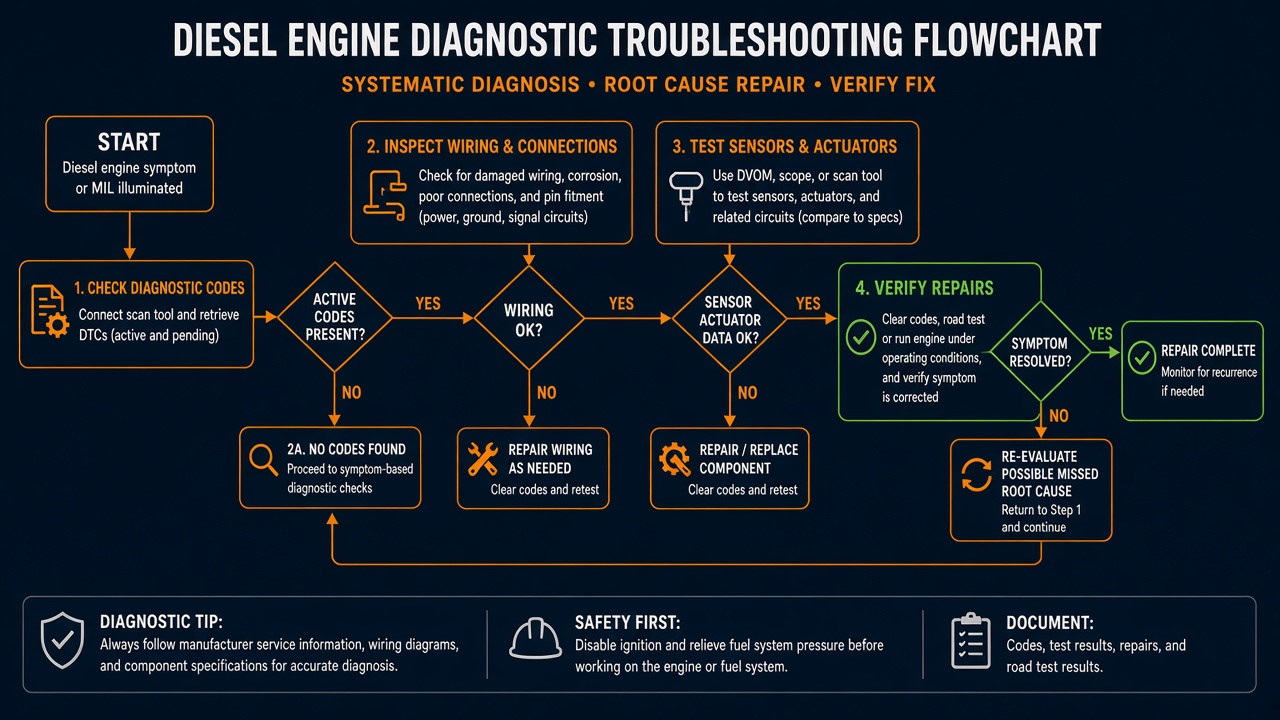
Diesel no-start and power-loss complaints resolve through a fixed sequence: confirm crank vs. no-crank, log all active and inactive J1939 or OBD-II codes with freeze-frame data, then test fuel supply (lift and rail pressure), charge-air integrity, smoke color at the tailpipe, and ground circuits before replacing parts. On 2010+ trucks, ECM derates from aftertreatment faults mimic engine failures—check DPF soot load, DEF consumption, and SCR efficiency before condemning fuel or turbo hardware. One misread code causes more comebacks than any single failed component.
Safety: Common-rail systems hold 5,000–30,000 psi at the rail; penetrating fuel injuries need emergency surgery—go to the ER immediately if fuel enters skin. Wear safety glasses and fuel-resistant gloves when opening fuel lines. Aftertreatment and turbo hardware exceed 800°F after shutdown; wait 30 minutes minimum before contact.
Baseline Data Before Disassembly
What to Document First
Before disconnecting a single connector, record:
- All active and inactive fault codes (J1939 for HD, OBD-II P-codes for pickups)
- Freeze-frame data for the primary code
- Engine hours or odometer
- Fuel type and last fill location
- Recent repairs or parts replaced
- DEF level and quality (if SCR-equipped)
A $40 notebook entry saves a $4,000 misdiagnosis. Shops have replaced $2,800 worth of injectors when the root cause was a $12 corroded ground strap under the battery tray.
No-Start Diagnosis: Crank-No-Fire vs. No-Crank
No-Crank Conditions
If the starter does not engage, you are in the electrical domain — not fuel, not air.
| Symptom | Likely Cause | Test Procedure | Typical Cost |
|---|---|---|---|
| Single click, no crank | Weak batteries / bad connection | Load test both batteries (minimum 750 CCA each for HD) | $280-$450 (batteries) |
| No click at all | Neutral safety / ignition switch | Verify 12V at starter solenoid trigger wire during crank | $150-$400 (switch) |
| Slow crank, no start | Parasitic draw / sulfated batteries | Voltage at starter during crank: must stay above 9.6V | $280-$900 |
On Cummins ISX and Detroit DD15 platforms, the ECM will not energize the starter relay if cab power drops below 11.5V. Always load-test batteries before chasing fuel codes on a no-crank.
Crank-No-Fire Conditions
The engine cranks at normal speed but does not fire. Work this list in order:
- Fuel supply — Is there fuel in the tank? Is the tank vent blocked? Three trucks have been pulled off the road where the fuel cap vent was plugged with mud, creating a vacuum that starved the lift pump.
- Lift pump pressure — Measure at the fuel filter inlet. Spec varies by engine:
- 6.7L Cummins: 10-15 psi at idle
- 6.7L Power Stroke (CP4.2): 8-12 psi
- L5P Duramax (CP4.2): 8-12 psi
- Detroit DD15 (gear pump): 60-90 psi (integrated lift)
- Rail pressure — Must build within 2-3 seconds of key-on on common-rail engines. No rail pressure = no start.
- Injector return flow — Excessive return flow bleeds rail pressure. Acceptable return per injector: under 80 mL/min at idle on most common-rail platforms.
- Compression — Diesel needs 350+ psi per cylinder to fire. A single dead cylinder from a dropped valve will crank but not start.
Glow Plug / Grid Heater Systems
On cold-start failures, verify intake air heating:
- 6.7L Cummins: grid heater relay, fuse #41 (2013-2018), resistance 0.5-2.0 ohms
- 6.7L Power Stroke: glow plug module, 11V at each plug during pre-heat cycle
- L5P Duramax: glow plugs draw 15-20 amps total during 6-second pre-heat
Ambient below 40°F without functional intake heat produces white smoke and extended crank times — not a fuel pump failure.
Power Loss and Derate Diagnosis
Understanding ECM Derate Levels
Modern diesel ECMs reduce power in stages. Knowing which stage you are in tells you which subsystem failed:
| Derate Level | Typical Trigger | Power Reduction | Driver Notice |
|---|---|---|---|
| Level 1 | Minor sensor fault | 10-25% | Slight sluggishness |
| Level 2 | Emissions fault (SCR, DPF) | 25-50% | Cannot maintain speed on grades |
| Level 3 | Severe fault (fuel, turbo) | 50-75% | 45 mph governor |
| Level 5 | Critical (oil pressure, coolant) | 75-100% | 5 mph limp or shutdown |
On Detroit DD15, derate level is visible in DiagnosticLink under “Vehicle Performance” → “Governor Status.” On Cummins INSITE, check “Features and Parameters” → “Engine Protection.”
Boost Leaks and Air System
Low boost is the number-one cause of power loss on trucks with 300,000+ miles. Test procedure:
- Pressurize the charge-air system to 15 psi with a boost leak tester (Cummins tool ST-1114-80 or aftermarket equivalent, ~$85)
- Spray soapy water at every CAC hose clamp, intercooler tank seam, and intake manifold gasket
- Listen for hissing at the turbo compressor outlet seal and VGT actuator rod boot
A pinhole leak at the intercooler outlet boot on a 6.7L Cummins drops boost by 8-12 psi under load. The truck feels fine at idle and falls on its face at 1,800 RPM.
Fuel Delivery Under Load
Rail pressure must hold spec under WOT (wide-open throttle). Log these parameters during a loaded road test:
- Rail pressure command vs. actual — deviation over 500 psi indicates pump wear or injector return issue
- Fuel temperature — above 140°F, fuel viscosity drops and aeration increases
- Mass air flow vs. calculated — on MAF-equipped engines, a 15%+ mismatch triggers limp mode
Smoke Color Diagnosis
Smoke color tells you which combustion parameter is wrong. Read it at the tailpipe after a 5-minute warm-up at idle.
Black Smoke (Rich Combustion)
Too much fuel or not enough air.
- Clogged air filter (check restriction gauge — replace at 25 in-H2O on HD)
- Failed turbo (low boost)
- Leaking injectors (return flow test)
- Stuck EGR valve (should be closed at WOT — log EGR position vs. command)
- Overfueling from a failed MAF or MAP sensor
White Smoke (Unburned Fuel or Coolant)
- Cold engine with bad glow plugs
- Low compression on one or more cylinders
- Coolant leak into combustion chamber — sweet smell at tailpipe, dropping coolant level with no external leak. Head gasket, EGR cooler (6.0L Power Stroke classic), or cracked head.
- Late injection timing from a stretched timing chain (Duramax LLY-LMM with 200,000+ miles)
Blue Smoke (Oil Consumption)
- Worn valve stem seals or turbo oil seal (check for oil in CAC pipes)
- Cylinder wall wear — compression test and leak-down
- Overfilled crankcase (diesel dilution from regens raises oil level)
Scan Tool Procedures: Reading Codes Correctly
J1939 vs. OBD-II
Heavy-duty trucks (Class 6-8) use SAE J1939 protocol. Pickups and vans use OBD-II with manufacturer-specific P-codes.
A J1939 fault code has three parts:
- SPN (Suspect Parameter Number) — what failed
- FMI (Failure Mode Identifier) — how it failed
- OC (Occurrence Count) — how many times
Example: SPN 157 FMI 3 = Rail pressure sensor, voltage above normal. This is a wiring or sensor fault — not a pump failure — until proven otherwise.
Stacked Codes: Read the Full List
Never fix the first code on the list. ECMs set secondary codes when a primary fault cascades. Example cascade on a DD15:
- SPN 3251 FMI 0 — DPF differential pressure high (PRIMARY)
- SPN 3714 FMI 0 — Aftertreatment DOC outlet temp low (SECONDARY)
- SPN 3364 FMI 1 — DEF quality (TERTIARY — may be unrelated)
Fix the DPF restriction first. The other codes often clear on their own.
Live Data Parameters Worth Logging
| Parameter | Normal Range (HD Cruise) | Red Flag |
|---|---|---|
| Rail pressure | 18,000-25,000 psi | Below 12,000 psi at cruise |
| Boost pressure | 22-32 psi | Below 15 psi under load |
| EGT (post-turbo) | 400-750°F | Above 1,200°F sustained |
| DPF delta-P | 0.5-3.0 in-H2O | Above 8.0 in-H2O |
| DEF consumption | 2-3% of fuel rate | Zero consumption = frozen line |
| Oil pressure | 40-65 psi at cruise | Below 25 psi at idle |
Electrical System Checks
Ground Integrity
Corroded grounds cause more ghost faults than any failed sensor. Check:
- Engine block ground strap (passenger side on Cummins, driver side on Detroit)
- Battery negative to frame
- ECM ground pins (typically pins 46 and 47 on Cummins ECM connector)
Resistance from battery negative to engine block must be under 0.1 ohms. Voltage drop during crank over 0.3V = bad ground.
Parasitic Draw and No-Crank on HD Trucks
When batteries test good but the starter does not engage on Cummins or Detroit platforms:
- Measure parasitic draw with doors closed and ECM timed out: under 50 mA is normal; above 200 mA drains batteries overnight
- At the starter relay, verify 12V+ on battery feed and 12V on trigger wire during crank request
- Check clutch/neutral safety switch on manual trucks—open circuit prevents crank
- On ISX with SmartSwitch dash: low cab voltage below 11.5V disables crank even with charged batteries—load test under crank, not open-circuit voltage
Intermittent no-crank from corroded battery hold-down hardware is common on fleet tractors—clean and torque hold-downs to 80–100 in-lb before replacing starters.
Connector Inspection
Pull, inspect, and dielectric-grease every connector in the fault circuit before replacing components. Look for green/white corrosion, retracted pins, broken lock tabs, and heat damage from nearby exhaust components.
Cooling System and Overheating
Overheating kills head gaskets and warps heads.
Thermostat and Water Pump
- Thermostat opens at OEM spec (typically 190°F or 203°F). Test in a pot of water — opens within 5°F of spec or replace. Cost: $35-$85 part, $150-$250 labor.
- Water pump weep hole dripping = bearing failure imminent. Cummins ISX water pump: part #4089909, ~$320, 3.5 hours labor.
EGR Cooler Leaks
The EGR cooler on 6.7L Cummins (2013-2018) and 6.7L Power Stroke cracks internally. Symptoms: overheat under load, white exhaust vapor, coolant loss with no external puddle. Replacement cost: $650-$1,200 (part) + 6-8 hours labor.
Aftertreatment-Related Driveability
If your truck is 2007 or newer (2010+ for most pickups), aftertreatment problems masquerade as engine problems. A forced regen that never completes will derate the truck to 5 mph.
Quick checks when aftertreatment is suspected:
- DEF level above 10%
- No DEF crystallization at the doser injector
- DPF soot load below 80%
- Last successful regen within 7 days of highway driving
Repair Cost Reference Table
| Repair | DIY Parts | Shop Total | Dealer Total |
|---|---|---|---|
| Fuel filter replacement | $45-$85 | $150-$250 | $200-$350 |
| Injector (single, common-rail) | $350-$650 | $600-$950 | $800-$1,200 |
| Turbocharger (reman) | $1,200-$2,200 | $2,500-$4,500 | $3,500-$6,000 |
| HP fuel pump (CP4) | $800-$1,400 | $1,800-$3,200 | $2,500-$4,000 |
| EGR valve | $250-$500 | $450-$800 | $600-$1,100 |
| Head gasket (pickup) | $200-$400 | $2,500-$4,500 | $3,500-$6,000 |
| ECM (reman) | $800-$1,500 | $1,200-$2,000 | $1,800-$3,000 |
Preventive Practices That Reduce Breakdowns
- Change fuel filters every 15,000 miles (HD) or per OEM interval
- Run a fuel additive with lubricity enhancer in ULSD
- Allow 3-minute idle cooldown after highway driving before shutdown
- Log DEF consumption — zero consumption means a frozen line or failed pump
- Keep battery terminals clean and tight
Cylinder Balance and Mechanical Testing
When electrical and fuel checks come back clean but the engine runs rough, move to mechanical testing.
Compression Testing
Use a diesel compression tester with the correct adapter for your glow plug or injector bore. Crank the engine with the throttle wide open and fuel disabled. Minimum acceptable compression varies by engine:
| Engine | Minimum Compression | Typical Good Reading |
|---|---|---|
| 6.7L Cummins | 310 psi | 350-400 psi |
| 6.7L Power Stroke | 300 psi | 340-380 psi |
| L5P Duramax | 310 psi | 350-390 psi |
| Cummins ISX15 | 350 psi | 400-450 psi |
| Detroit DD15 | 340 psi | 390-440 psi |
Variation between cylinders should not exceed 10%. A cylinder reading 80 psi below the highest indicates a valve seat issue, blown head gasket, or cracked piston — not an injector problem.
Cylinder Cutout Test
Most HD scan tools can disable individual injectors while monitoring engine speed drop. A cylinder that causes less than 50 RPM drop when cut out is dead or weak. This test isolates the problem cylinder without pulling the head. On Cummins INSITE, use “Cylinder Cutout Test” under Engine Tests. Run at 1200 RPM stabilized — never at idle, where speed drop is too small to measure accurately.
Leak-Down Testing Procedure
Leak-down complements compression testing when variation exceeds 10%:
- Rotate engine to TDC on the test cylinder
- Pressurize cylinder to 80 psi via spark plug or injector port adapter
- Measure pressure drop over 60 seconds—under 15% is acceptable
- Listen at intake (intake valve), exhaust (exhaust valve), crankcase (rings), and coolant fill (head gasket)
Leak-down above 25% at crankcase with good compression on adjacent cylinders indicates ring groove wear—not always visible on a compression test alone. On 6.7L Power Stroke, leak-down at the coolant reservoir with no external leak confirms EGR cooler or head gasket failure before pulling the head.
Frequently Asked Questions
Why does my diesel crank but not start after running out of fuel?
Running a common-rail system dry introduces air into the high-pressure circuit. Crack injector lines at the rail and crank until fuel flows without bubbles, or use a scan tool fuel priming routine. On Cummins, INSITE has a “Fuel System Priming” routine. Budget 30-60 minutes of shop time.
Can a bad DEF quality sensor cause a no-start?
No. DEF quality faults cause derate, not no-start. If your truck cranks but will not fire, focus on fuel, air, and compression.
How do I tell if my turbo is bad or just leaking boost?
Pressurize the charge-air system to 15 psi with the engine off. If you find a leak at a hose clamp, fix that first. If the system holds pressure but boost is still low at WOT, inspect the compressor wheel for shaft play (more than 0.015” lateral = rebuild) and oil in the housing.
What is the most common misdiagnosis you see?
Replacing the fuel pump when the problem is a clogged fuel filter or air in the system. Always measure lift pressure and rail pressure before ordering a $1,800 HP pump.
Should I clear codes before or after the repair?
Clear after the repair, never before diagnosis. Inactive codes and freeze-frame data tell you what conditions existed when the fault set.
How long can I drive with a check engine light on a diesel?
An SPN 3251 (DPF restriction) at 60% soot load — you have days. At 95% — miles before a 5 mph derate. An oil pressure code — stop immediately. Read the severity in your scan tool.
What scan tool do I need for heavy-duty diesel?
Minimum: J1939-capable. Options range from $200 (OBDLink MX+ with J1939 adapter) to $3,000+ (Cummins INSITE, Detroit DiagnosticLink). For fleet work, OEM tools pay for themselves in one avoided misdiagnosis.
Sources
- SAE J1939-71 — Suspect Parameter Number and FMI definitions for HD diagnostics
- Cummins QuickServe Online — ISB6.7 and ISX15 no-start and derate diagnostic trees
- Detroit Diesel DiagnosticLink 8.19 — Vehicle Performance governor and aftertreatment monitors
- Ford OASIS — 6.7L Power Stroke fuel system pressure and FICM tests
- ATA Technology & Maintenance Council RP 1214 — electrical fault troubleshooting on commercial vehicles
Related Reading
- Diesel Fuel System Diagnostics — rail pressure, return flow, and CP4 failure patterns
- Diesel Turbocharger Guide — boost leak testing and VGT actuator diagnosis
- DPF System Explained — soot load stages and regen failures that trigger derates
- SPN 3251 FMI 0: DPF Soot Load High — aftertreatment codes that mimic engine faults
- SPN 1569 FMI 31: Engine Protection Derate — staged power reduction limits
- Repair Cost Estimator — shop vs. DIY pricing by platform