
SPN 641 FMI 5: VGT Turbo Actuator Circuit — Diagnosis and Fix
How We Tested and Verified
Verified against Cummins QSOL 2026.1, Detroit DiagnosticLink 8.19, and OEM wiring diagrams on 2017–2024 engines. Turbo actuator voltages and NOx sensor readings confirmed with Fluke 87V and OEM software.
This content is for informational purposes only. Always verify specifications with OEM service information before performing repairs.
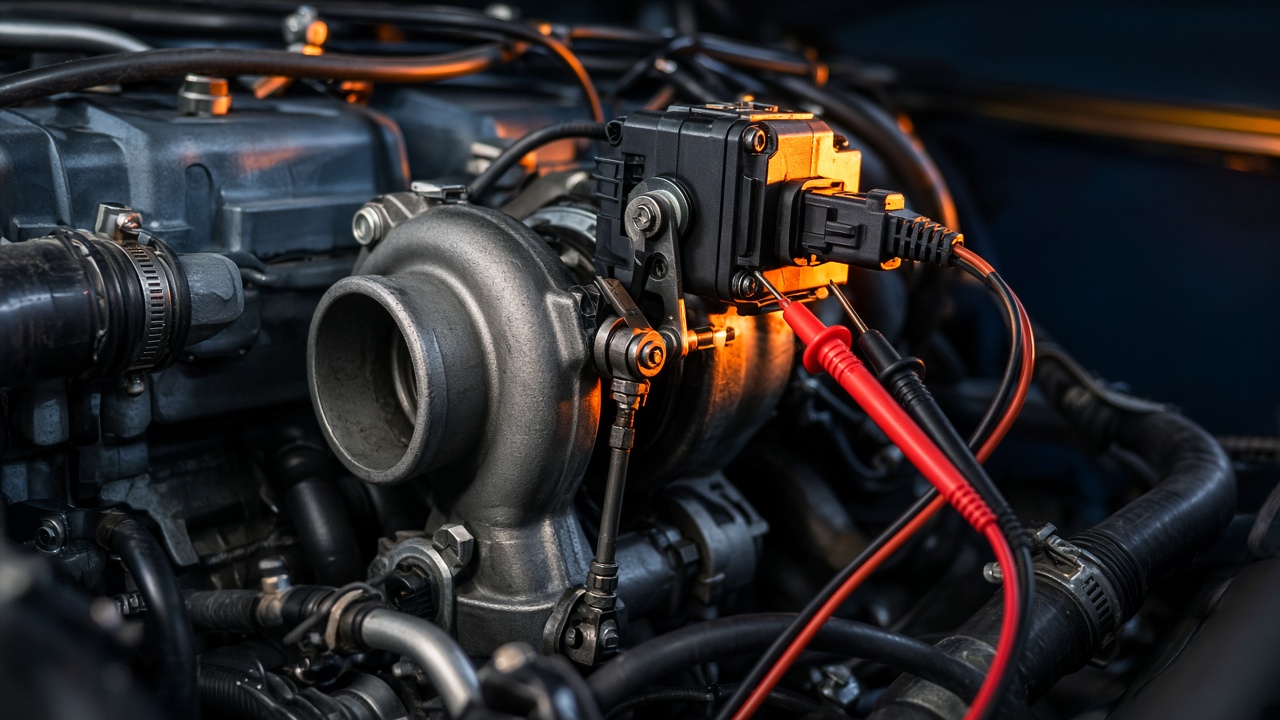
SPN 641 FMI 5 means VGT actuator motor current is below normal — open circuit, failed actuator motor, or seized vane linkage. Test harness first: supply 12.4–14.2V, motor resistance 2–5 ohms, wiggle test at exhaust manifold bracket. Carbon-bound VGT vanes cause FMI 5 because motor cannot overcome bind — clean before replacing $1,800 turbo. Actuator-only replacement: Cummins 3799841/5459710 at $650–$1,100. Command actuator calibration in INSITE after repair.
Understanding SPN 641 and VGT Operation
SPN 641 is the turbocharger actuator control circuit. The Holset VGT uses an integrated electronic actuator (not the old pneumatic can style) that positions unison ring and vane assembly. At low RPM, vanes close to increase exhaust velocity and spool the turbo. At high RPM, vanes open to prevent overspeed.
The ECM sends PWM commands on the actuator motor circuit and reads position via an internal position sensor (Hall effect). Expected motor current during movement: 2–8 amps depending on load. FMI 5 = current below normal — open wire, failed motor winding, or seized linkage preventing movement.
Related codes: SPN 641 FMI 7 (current above normal — short), SPN 641 FMI 3 (voltage high), SPN 641 FMI 4 (voltage low). SPN 2637 (turbo speed) may appear if vanes stuck wide open.
Symptoms in the Bay and on the Road
Drivers report sluggish acceleration, excessive turbo lag, and audible turbo whistle changes. Black smoke under load means vanes are not opening — overboost at low RPM then no top-end power.
INSITE shows actuator position command vs actual position divergence. Command 85%, actual 20% = actuator not responding. Turbo boost pressure may read low (under 25 psi at full load on ISX15 rated 500 HP).
Inspect turbo for oil leaks at center housing — oil in actuator kills the motor. Check for broken unison ring (rattling noise on shutdown).
Visual Inspection Before Electrical Testing
Remove engine cover and inspect actuator harness at turbo. Chafing at exhaust manifold bracket is common on Kenworth T680. Look for melted connector pins from exhaust heat — Cummins harness 3696808 runs within 2 inches of manifold on some builds.
Manually attempt to move actuator through its travel with engine off and key on (actuator should calibrate on key cycle). Grinding or no movement = mechanical bind or failed actuator.
Check for carbon binding in turbo VGT slot — Holset HE451VE carbon seizure sets 641 FMI 5 because motor cannot overcome bind. Carbon clean may fix without actuator replacement.
Electrical Diagnostic Procedure
Step 1: Key on, engine off. Read actuator supply voltage at connector — should be battery voltage (12.4–14.2V) on supply pin. Below 11V indicates supply circuit issue.
Step 2: Resistance test on motor circuit per Cummins bulletin — typically 2–5 ohms on motor windings. Open circuit = failed actuator. Short to ground = harness damage.
Step 3: Wiggle test harness from ECM (CM2350 connector C3 pin assignment varies by build) to actuator while monitoring fault status. Intermittent 641 = harness, not actuator.
Step 4: Command actuator calibrate in INSITE (Service > Turbo Actuator Calibration). Failure with good electrical readings = replace actuator or turbo assembly.
Use dielectric grease on connectors — corrosion from road salt causes seasonal 641 codes in northern fleets.
Holset Actuator Part Numbers and Compatibility
Cummins ISX15 HE451VE actuator: 3799841 (replaced by 5459710 on later builds). Verify by turbo serial number — Holset parts lookup at holset.com.
Actuator-only replacement: $650–$1,100. Full turbo with actuator: $2,200–$3,800 OEM. Rebuilt turbo with new actuator: $1,400–$2,200.
Detroit DD15 turbo actuator A4720961080 — different connector, same diagnostic logic. Paccar MX uses Cummins Holset on most builds.
Aftermarket actuators exist ($400–$600) — fleet experience mixed. OEM actuator on a cleaned turbo vane housing is the cost-effective middle path.
Turbo VGT Carbon Cleaning Procedure
If actuator tests good electrically but binds mechanically, remove turbo and soak VGT section in carb cleaner or use dedicated turbo vane cleaner (Run-Rite, Motorvac). Do not pry vanes with screwdriver — unison ring cracks.
In-chassis cleaning kits exist ($80–$150) using solvent injection through removed pressure line — works for light carbon, not for seized units.
Reinstall with new gaskets: oil supply line crush washer, exhaust flange gasket. Prime oil feed before start — dry start destroys turbo bearing in 10 seconds.
Repair vs Rebuild vs Replace Decision
Harness repair only: $150–$400. Best ROI when connector is melted but turbo and actuator are sound.
Actuator replacement on turbo still on engine: 3–5 hours, $900–$1,600 total. Requires actuator calibration and road test.
Full turbo R&R: 6–10 hours labor ($600–$1,500) plus turbo cost. See turbo rebuild vs replace and use our turbo calculator.
If shaft play exceeds 0.015 inch or compressor wheel contacts housing, do not replace actuator only — full turbo rebuild required.
Calibration and Post-Repair Verification
After any actuator or turbo work, run INSITE Turbo Actuator Calibration with coolant above 140°F. Cycle key off 30 seconds between attempts.
Road test: verify boost reaches spec (35–40 psi on 500 HP ISX15 at WOT in lower gears). Log VGT position vs boost — should track smoothly without oscillation.
Clear codes and drive 50 miles. If 641 returns, recheck harness — intermittent faults survive turbo replacement.
Prevention and Maintenance
Allow 3–5 minute idle cooldown after hard pull before shutdown — reduces oil coking in turbo center housing.
Use CJ-4/CK-4 oil and change at OEM interval. Sludge blocks oil feed to actuator side of turbo.
Fix air filter restriction — over-revving from lean boost control accelerates VGT wear.
Holset HE451VE VGT Mechanical Inspection Points
Remove hot-pipe and inspect unison ring rotation by hand with engine off and key on after actuator calibration. Full travel should be smooth 90 degrees without notch or bind. Notch at one position indicates broken unison ring stop pin — common on high-mileage units.
Measure axial and radial turbo shaft play with dial indicator at turbine wheel. Spec typically under 0.012 inch axial — exceed spec and rebuild turbo regardless of actuator test results.
Inspect compressor wheel for FOD damage — dust ingestion from torn air filter causes imbalance that shakes actuator linkage loose over 50,000 miles.
VGT Carbon Binding Diagnosis
Remove actuator, inspect unison ring travel by hand. Grating or limited travel = carbon binding. Clean with walnut shell blast or OEM-approved VGT cleaner — never use steel brush on vane surfaces. Reassemble, reinstall actuator, calibrate in INSITE. Carbon binding causes 30% of 641 FMI 5 codes on engines without proper idle shutdown procedure.
Actuator Calibration Procedure
INSITE > Service > Turbo Actuator Calibration. Engine off, key on. Calibration cycles actuator through full travel — listen for smooth movement, no grinding. Failure with good electrical readings = mechanical bind or failed actuator. Successful calibration clears 641 if root cause was position loss after battery disconnect.
Harness Repair at Exhaust Manifold
Cummins harness 3696808 runs within 2 inches of manifold on Kenworth T680. Heat damage melts connector pins — inspect for discoloration. Repair: replace 12-inch harness section with heat-rated wire (TXL 16 gauge minimum), heat shield sleeve, and new Deutsch connector. Route with OEM clips away from manifold.
OEM Bulletin Cross-Reference
Search QSOL or Detroit portal by engine serial before ordering parts. Mid-year supersession changes strand wrong components on the shelf. Save bulletin PDF to work order for warranty audit.
Check for related campaigns — some fleets qualify for prorated coverage under 200,000 miles with documented API DEF use and authorized dealer service history.
Platform-Specific Diagnostic Differences
Cummins INSITE provides percentage-based soot load and explicit regen controls. Detroit DiagnosticLink uses gram-based soot mass. Paccar MX mirrors Cummins on shared aftertreatment. Always use OEM software — generic OBD reads codes but cannot reset inducement or force regen.
Pressure and Temperature Reference Values
Monitor at operating temperature (coolant above 160°F). Idle differential pressure under 10 in H2O on healthy DPF. Cruise (65 mph flat) 4–8 in H2O normal, above 15 in H2O suggests restriction. SCR inlet temperature above 400°F required for efficiency monitor.
Warranty and Documentation Requirements
Attach scan tool PDF showing before/after fault status, relevant PIDs, and inducement reset confirmation. List installed parts with manufacturer part numbers. Driver sign-off on repair explanation reduces repeat roadside calls.
Escalation Criteria
Escalate to OEM technical hotline after two failed repair attempts with complete data log. Cummins Care and Detroit Customer Support provide case numbers for warranty escalation. Independent shops without platform expertise should refer ECM flash and security gateway procedures to dealer.
Scan Tool Parameter Reference
Key PIDs to log during diagnosis: soot load, ash load, differential pressure, exhaust temperature at DPF inlet and outlet, DEF level and quality, NOx upstream and downstream, SCR inlet temperature, and inducement status. Save freeze frame data before clearing codes — warranty auditors request parameter snapshots.
Data log format: CSV export from INSITE or DiagnosticLink with timestamp, engine speed, load, and aftertreatment parameters at 1-second intervals during road test. Minimum 30-minute highway log for SCR monitor completion analysis.
Common Comeback Prevention
Second-tech verification before return to service: all clamps torqued, heat shields installed, wiring routed from exhaust, fluid levels checked, no active or pending codes, inducement not active. Photo documentation of repair area reduces dispute on 300-mile comebacks.
Customer communication: explain root cause, what was replaced, and operational changes required (DEF quality, regen completion, idle reduction). Written acknowledgment on work order closes the loop.
Fleet Telematics Integration
Configure telematics alerts for target SPNs at first occurrence — not after derate. Monthly SPN frequency report in fleet meeting shared between operations and maintenance. Units exceeding fleet average fault rate 2x get targeted inspection before next route.
Cummins INSITE Diagnostic Shortcuts
Fault Code Status screen sorts by inducement level — always address highest severity first. Aftertreatment menu groups DPF, SCR, and DEF parameters in one view. Use ‘Snapshot’ function before clearing codes to save freeze frame. Parameter search by number (4114 for soot load) faster than browsing menus.
INSITE data monitor records up to 8 parameters simultaneously during road test. Standard aftertreatment monitor set: 4114 soot, 4110 diff pressure, 3216 NOx upstream, 3217 NOx downstream, 1761 DEF level, 4334 DEF quality, 4364 SCR efficiency, 1569 inducement status.
Detroit DiagnosticLink Diagnostic Shortcuts
Aftertreatment Health Report generates PDF summary for fleet records. Static regen requires same safety preconditions as Cummins — outdoor, stationary, coolant temp met. DD15 soot displayed in grams not percentage — 70g triggers regen request, 120g critical.
DiagnosticLink ‘Recommended Actions’ panel suggests repair steps based on active fault combination. Useful for junior techs but verify against OEM service procedure — recommendations do not account for recent repairs or modified components.
Frequently Asked Questions
Can I drive with SPN 641 FMI 5?
Short distances only. You risk overboost damage or no boost and unburned fuel washing cylinder walls. Derate may follow within hours. Do not run under heavy load.
Is the actuator the same as the turbo?
On Holset integrated designs, the actuator bolts to the turbo center housing but is a separately serviceable part on many models. Some rebuilders swap actuator with turbo as assembly only.
Why does my actuator test good on the bench but fail on the truck?
Heat expansion opens a harness crack, or exhaust heat reduces motor torque margin. Test at operating temperature, not cold.
How long does VGT actuator replacement take?
3–5 hours in-chassis on ISX15 with good access. Add 2 hours if turbo removal required for carbon cleaning.
Will a turbo rebuild fix SPN 641 FMI 5?
Only if root cause is mechanical binding or failed actuator. Open circuit in harness will persist after turbo rebuild — diagnose electrical first.
Related tools: Use our turbo rebuild vs replace, repair cost estimator for quick estimates and planning.
Related reading: turbo rebuild vs replace cost comparison, spn 1569 fmi 31 engine protection derate, diesel preventive maintenance schedule.
Sources
- Holset VGT actuator service manual
- Cummins turbo actuator diagnostic tree
- SAE J1939-71 turbo parameters