
SPN 4364 FMI 18: SCR Efficiency Low — Complete Diagnostic Guide
How We Tested and Verified
Verified against Cummins QuickServe Online (QSOL) 2026.1, Detroit Diesel DiagnosticLink 8.19, and field diagnosis on 2018–2024 ISX15, X15, DD13, and DD15 engines with OEM-level scan tools at operating temperature.
This content is for informational purposes only. Always verify specifications with OEM service information before performing repairs.
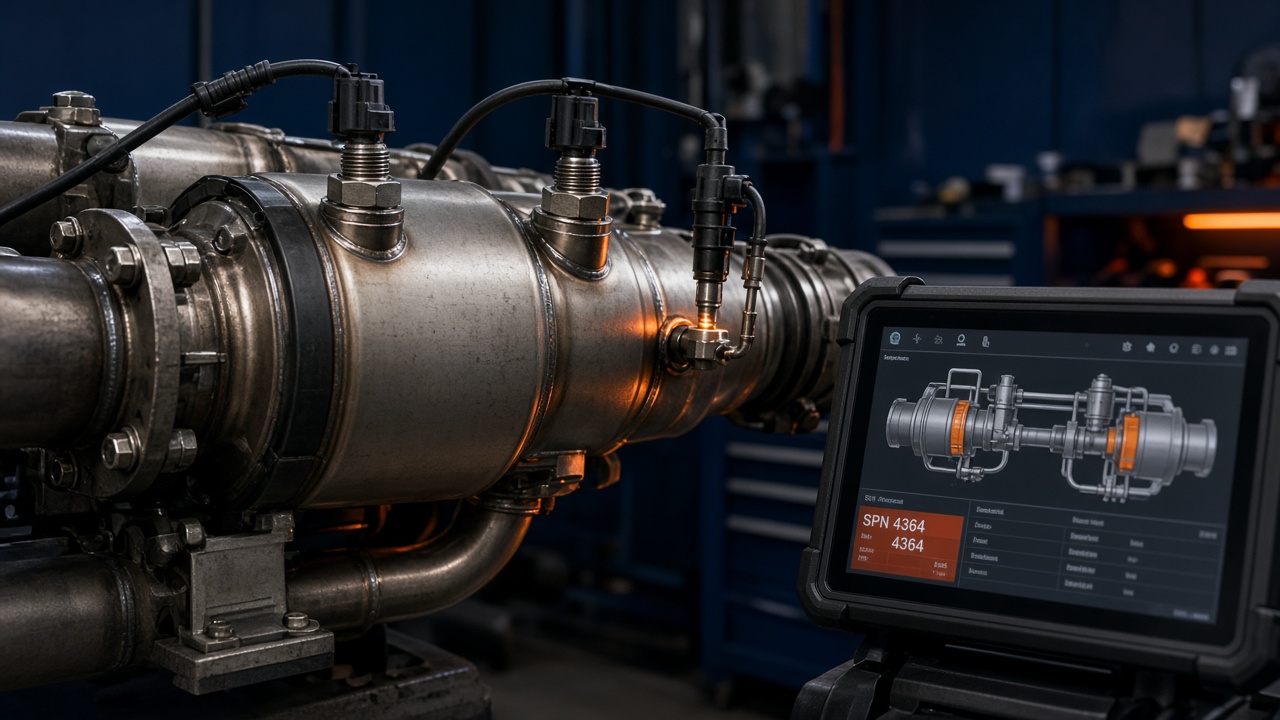
SPN 4364 FMI 18 means SCR NOx conversion efficiency dropped below 85% threshold. Check DEF concentration first — refractometer reading must be 32.5% urea (±0.5%). Then test both NOx sensors (heater 4–8A, signal not stuck). Verify DEF doser pressure at 130–180 psi on Cummins. Exhaust leak between sensors destroys efficiency calculation — smoke-test from DPF outlet to tailpipe. Catalyst replacement ($5,000–$9,000) only after confirming good DEF, working doser, valid sensors, and no leaks.
How the ECM Calculates SCR Efficiency
The aftertreatment control module compares upstream NOx (before SCR) against downstream NOx (after SCR). Under steady cruise load, conversion efficiency should exceed 85–95%. When downstream NOx stays too high relative to upstream, the efficiency calculation drops and SPN 4364 sets.
Cummins uses SPN 4364 across CM2350, CM2450, and CM2560 platforms. The monitor requires valid readings from both NOx sensors, DEF dosing confirmed by the DEF quality sensor, and exhaust temperature above 400°F at the SCR inlet for the monitor to run.
FMI 18 is “low” — distinct from FMI 2 (erratic data) which points to sensor plausibility failure. If you have both 4364 FMI 18 and 3216 FMI 20, fix the sensor first before condemning the catalyst.
Common Symptoms Beyond the Check Engine Light
Active SCR inducement: flashing MIL, DEF warning lamp, countdown timer to 5 mph derate on Cummins (typically 100 engine hours from first warning). Detroit may use torque derate without countdown on EPA17.
Visible white crystallization around DEF injector (dosing module) indicates urea crystallization from leaks or heat soak. DEF consumption may appear normal on the dash gauge but actual dosing could be low due to clogged injector.
Fuel economy may appear normal — unlike DPF issues, SCR failure does not always change fuel numbers until derate activates.
DEF Quality: The First Thing to Check
Pull a DEF sample and test with a refractometer. Correct concentration: 32.5% urea (±0.5%). Reading of 30% or below causes chronic 4364. Watered DEF from improper storage is the number-one root cause in summer fleets.
DEF freezes at 12°F — partial thawing leaves diluted layers. DEF shelf life is 12 months at 75°F; above 86°F degradation accelerates. Smell test: ammonia odor should be sharp. Sweet or absent smell suggests contamination.
Cummins DEF quality sensor (part 5406046 on many X15) reads urea concentration electrically. Failed sensor reads “quality OK” when fluid is bad — always verify with refractometer, not just ECM data.
Drain and flush DEF tank if contamination suspected. Tank cleaning $200–$400. Replace inline filter (Cummins 5406048) every 200,000 miles or with any contamination event — filter is $45–$80.
NOx Sensor Testing and Replacement
Upstream NOx sensor (before SCR) and downstream (after SCR) must agree with plausibility limits. Swap-test: if efficiency suddenly reads fine after swapping sensor positions, you found the bad sensor. Do not swap permanently — positions are calibrated.
Bench test heating circuit: NOx sensors draw 4–8 amps during heat-up. Off-engine resistance on signal circuit varies by manufacturer; use OEM test procedure. See our NOx sensor multimeter guide.
Cummins upstream NOx sensor 5WK96681x series: $400–$650. Downstream $450–$700. Detroit A0101534828: $500–$750. Labor 1.5–2.5 hours per sensor including heat soak cool-down before removal.
Sensor sockets are 22mm or 27mm depending on platform. Apply anti-seize to threads — exhaust flange galling is common. Torque to spec (typically 35–45 Nm).
DEF Dosing Module and Injector Diagnosis
The dosing module (Cummins part 4387308 on ISX15, Detroit A0001401080 on DD13) meters DEF into the decomposition tube. Failure modes: crystallized injector tip, failed module pump, electrical harness chafing at frame rail.
INSITE command: “DEF Doser Test” — listen for pump prime and watch DEF pressure (target 130–180 psi on Cummins). Zero pressure with good fluid = failed pump or clogged filter.
Injector line heat trace failure causes frozen DEF lines in winter — sets 4364 after thaw because dosing was interrupted. Replace harness sections $150–$300, full dosing module $1,200–$2,400 installed.
Exhaust Leaks That Fool SCR Efficiency
Any leak between upstream NOx sensor and SCR inlet, or between SCR outlet and downstream NOx sensor, admits ambient air and destroys efficiency calculations. Smoke test the exhaust from DPF outlet to tailpipe.
Common leak points: V-band clamp at DOC outlet, flex pipe before SCR, SCR brick sealing gasket. A 1/8-inch leak can drop apparent efficiency 20 points.
Clamp torque: 18–25 ft-lbs on 4-inch V-bands — over-torque crushes flanges, under-torque leaks. Replace gaskets when disturbed; reuse causes repeat leaks.
SCR Catalyst Deactivation and Replacement
Catalyst loses efficiency from sulfur poisoning (low-quality fuel), coolant contamination (leaking EGR cooler or head gasket), oil ash from failed turbo seals, and physical damage from thermal shock.
If DEF is good, sensors test OK, dosing confirmed, no exhaust leaks, and efficiency still below 70% on a forced regen drive cycle — catalyst is depleted. Replacement SCR assembly: $3,500–$6,500 parts, 6–10 hours labor.
Catalyst life expectancy: 500,000–800,000 miles with good DEF and no coolant events. Coolant leak into exhaust destroys SCR in under 5,000 miles — always pressure-test cooling system when 4364 appears with white exhaust vapor.
Derate Timelines and Legal Exposure
Cummins inducement strategy (EPA13+): Stage 1 warning → Stage 2 torque reduction (25%) → Stage 3 severe derate (5 mph). Total timeline from first 4364 to 5 mph: as few as 100 engine hours if ignored.
CARB enforces visible exhaust smoke and tampering during roadside inspections. SCR inoperative with delete or bypass carries $1,000–$10,000 penalties per violation in California.
Document all DEF purchases and service — warranty claims on dosing modules require proof of API-certified DEF (ISO 22241).
Repair Cost Summary
Best case: bad DEF, drain and refill ($150–$300 DEF + 1 hour labor). Sensor replacement ($600–$1,200 total). Dosing module ($1,800–$3,500 installed). Worst case: SCR catalyst ($5,000–$9,000).
Fleet strategy: refractometer in every shop ($40–$80 for a good optical unit), DEF sample log per vehicle, replace NOx sensors at 400,000 miles preventively on high-mileage units.
| Root cause | Typical repair cost |
|---|---|
| Contaminated DEF | $200–$500 |
| NOx sensor (one) | $600–$1,200 |
| DEF dosing module | $1,800–$3,500 |
| SCR catalyst assembly | $5,000–$9,000 |
| Exhaust leak repair | $150–$600 |
NH3 Slip and Secondary SCR Faults
Some 2020+ calibrations monitor ammonia slip downstream of SCR using additional sensing logic. High NH3 slip can trigger efficiency-related faults separate from NOx sensor disagreement. Causes include overdosing from stuck-open DEF injector or incorrect DEF concentration causing ECM to over-compensate.
Verify DEF concentration before replacing catalyst. A 28% urea solution causes overdosing logic errors that mimic catalyst failure — refractometer reading takes five minutes and saves $6,000.
Detroit DiagnosticLink includes NH3-related PIDs on EPA17 — log during highway cruise. Downstream NOx should not read zero while upstream reads high; that pattern suggests sensor stuck low, not miracle SCR performance.
Fleet Case Study: Midwest Linehaul SCR Failures
A 40-truck fleet running Chicago-Dallas saw 12 SCR inducement events in one summer. Root cause: bulk DEF tote stored outside without shade — urea degraded to 29%. After tote relocation and tank drain on affected units, inducement events dropped to zero over 90 days.
Lesson: DEF supply chain is part of emissions repair. Question every driver about where they fill DEF jugs — gas station DEF turnover varies. Date-code DEF bottles when possible.
Fleet implemented monthly refractometer spot checks on 10% random sample. Cost $0 labor at PM — prevented an average $2,800 repair per caught contamination event.
DEF Refractometer Testing Protocol
Draw sample from tank bottom (where water settles) and top. Both should read 32.5% urea ±0.5%. Mismatch between top and bottom indicates stratification from freeze-thaw. Drain 2 gallons from bottom before refilling if diluted layer detected. Refractometer cost: $30–$80 — cheapest diagnostic tool in aftertreatment.
DEF Doser Pressure Test Detail
INSITE command: DEF Doser Test. Target pressure 130–180 psi on Cummins. Listen for pump prime cycle (2–3 seconds whine at key-on). Zero pressure with good fluid: clogged inline filter (replace 5406048, $45–$80) or failed pump. Partial pressure: crystallized injector tip — remove and soak in distilled water.
SCR Catalyst End-of-Life Indicators
Efficiency below 70% after confirming DEF, sensors, dosing, and no exhaust leaks. Coolant contamination destroys SCR in under 5,000 miles — always pressure-test cooling system when 4364 appears with white exhaust vapor. Sulfur poisoning from off-spec fuel reduces catalyst life 30–50%.
OEM Bulletin Cross-Reference
Search QSOL or Detroit portal by engine serial before ordering parts. Mid-year supersession changes strand wrong components on the shelf. Save bulletin PDF to work order for warranty audit.
Check for related campaigns — some fleets qualify for prorated coverage under 200,000 miles with documented API DEF use and authorized dealer service history.
Platform-Specific Diagnostic Differences
Cummins INSITE provides percentage-based soot load and explicit regen controls. Detroit DiagnosticLink uses gram-based soot mass. Paccar MX mirrors Cummins on shared aftertreatment. Always use OEM software — generic OBD reads codes but cannot reset inducement or force regen.
Pressure and Temperature Reference Values
Monitor at operating temperature (coolant above 160°F). Idle differential pressure under 10 in H2O on healthy DPF. Cruise (65 mph flat) 4–8 in H2O normal, above 15 in H2O suggests restriction. SCR inlet temperature above 400°F required for efficiency monitor.
Warranty and Documentation Requirements
Attach scan tool PDF showing before/after fault status, relevant PIDs, and inducement reset confirmation. List installed parts with manufacturer part numbers. Driver sign-off on repair explanation reduces repeat roadside calls.
Escalation Criteria
Escalate to OEM technical hotline after two failed repair attempts with complete data log. Cummins Care and Detroit Customer Support provide case numbers for warranty escalation. Independent shops without platform expertise should refer ECM flash and security gateway procedures to dealer.
Scan Tool Parameter Reference
Key PIDs to log during diagnosis: soot load, ash load, differential pressure, exhaust temperature at DPF inlet and outlet, DEF level and quality, NOx upstream and downstream, SCR inlet temperature, and inducement status. Save freeze frame data before clearing codes — warranty auditors request parameter snapshots.
Data log format: CSV export from INSITE or DiagnosticLink with timestamp, engine speed, load, and aftertreatment parameters at 1-second intervals during road test. Minimum 30-minute highway log for SCR monitor completion analysis.
Frequently Asked Questions
Can I use agricultural urea instead of DEF?
No. Agricultural urea contains aldehydes, biuret, and metals that destroy SCR catalysts. Only use API-certified DEF meeting ISO 22241. The cost difference is pennies per gallon; catalyst replacement is thousands.
How do I know if my SCR catalyst is bad vs the NOx sensor?
Perform a regen drive cycle with OEM software logging upstream and downstream NOx PIDs. If upstream reads 800 ppm and downstream reads 600 ppm at cruise, SCR is working but marginally. If downstream equals upstream, SCR or dosing is failed. Erratic sensor readings with good heat-up current = sensor.
Will SPN 4364 clear after fixing DEF?
After draining bad DEF, refilling, and completing a 200+ mile highway drive cycle with SCR temp above 450°F, the monitor will re-run and clear if efficiency recovers. May take 2–3 drive cycles.
What is the difference between SPN 4364 FMI 18 and FMI 1?
FMI 18 is efficiency below threshold (low). FMI 1 is data valid but below minimum — often used interchangeably by OEMs. FMI 2 means erratic/implausible data — chase sensors and wiring first.
Does idling affect SCR efficiency monitoring?
Yes. The efficiency monitor typically does not run at idle because SCR inlet temp is too low. Chronic idlers may delay monitor completion, keeping the code active longer even after repair.
How long does SCR efficiency monitor take to complete after repair?
Typically 30–90 minutes of highway driving with SCR inlet above 450°F. Multiple key cycles may be required.
Related tools: Use our repair cost estimator, maintenance schedule for quick estimates and planning.
Related reading: spn 3216 fmi 20 nox sensor failure, test nox sensor multimeter, comply carb regulations.
Sources
- Cummins SCR system service manual
- ISO 22241 DEF quality standard
- SAE J1939-71 SCR parameters