
SPN 3251 FMI 0: DPF Soot Load High — Diagnosis and Repair
How We Tested and Verified
Verified against Cummins QuickServe Online (QSOL) 2026.1, Detroit Diesel DiagnosticLink 8.19, and field diagnosis on 2018–2024 ISX15, X15, DD13, and DD15 engines with OEM-level scan tools at operating temperature.
This content is for informational purposes only. Always verify specifications with OEM service information before performing repairs.
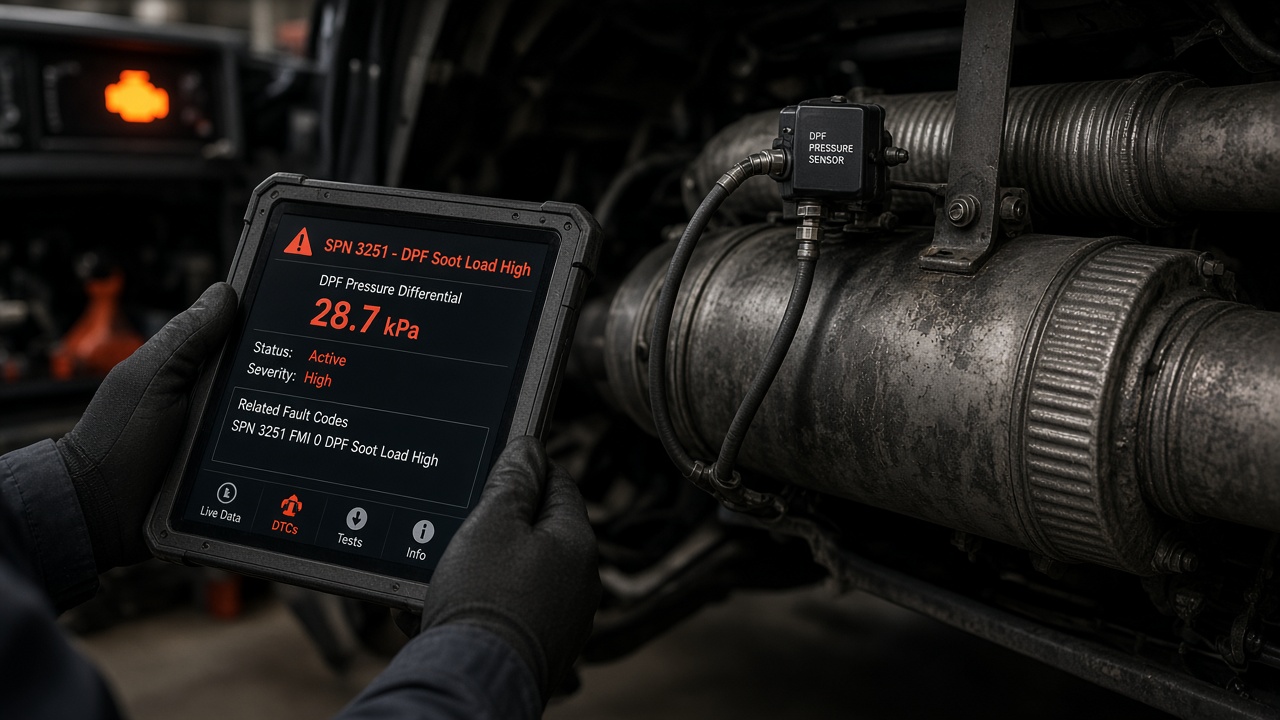
SPN 3251 FMI 0 means DPF soot load exceeds the regen threshold — above 80% on Cummins INSITE or 70–80 grams on Detroit DD15. Force a parked regen immediately: coolant above 140°F, fuel above 25%, stationary outdoors, 20–45 minutes duration. If soot stays high after successful regen, check ash load (clean above 80%) and differential pressure sensors ($180–$320 each). Ignoring 3251 leads to FMI 16 and SPN 1569 engine protection derate at 5 mph within 50–100 miles.
What SPN 3251 FMI 0 Actually Means
Suspect Parameter Number 3251 refers to the diesel particulate filter soot load estimate. Failure Mode Identifier 0 indicates the data is valid but above the normal operating range — not a sensor circuit fault. The ECM uses a model-based calculation combining differential pressure across the DPF (measured by upstream and downstream pressure sensors), exhaust gas temperature, engine load history, and time since last successful regeneration.
On Cummins ISX15 and X15 engines (CM2350 and later), soot load is displayed as a percentage in INSITE under Aftertreatment > DPF Status. Values above 80% trigger the code. Detroit DD13/DD15 reports soot mass in grams; above approximately 70–80 grams you will see active regen requests and eventually this SPN. Paccar MX-13 uses a similar percentage model tied to SPN 3251.
FMI 0 is different from FMI 1 (below normal) or FMI 2 (erratic). With FMI 0, the measurement chain is considered functional — the filter is genuinely full of soot, or the model has not been reset after a filter change or forced regen abort.
Symptoms You Will See in the Cab and on the Scan Tool
Drivers report the HEST (High Exhaust System Temperature) lamp, reduced power if soot continues to climb, and frequent active regens that may not complete. Fuel economy drops 3–8% because the truck spends more time in regen enrichment and post-injection events.
In INSITE, monitor Parameter 4114 (DPF Soot Load Percent) and Parameter 4110 (DPF Differential Pressure). Healthy differential pressure at cruise (65 mph, flat ground) is typically 4–8 inches H2O on a clean filter. Above 12–15 in H2O at steady cruise strongly suggests plugging — either soot or ash.
Check for active and inactive fault codes: SPN 3251 FMI 16 (extremely high), SPN 3710 (DPF differential pressure high), SPN 3364 (DEF quality), and SPN 4364 (SCR efficiency) often appear in the same failure chain when aftertreatment is neglected.
Root Causes: Soot Accumulation vs False Modeling
Real soot overload happens from interrupted regens (city driving, short hauls under 40 miles), excessive idle time (more than 30% idle ratio), failed EGR cooler leaks diluting exhaust chemistry, or a stuck-closed EGR valve causing rich combustion. Each aborted regen adds 5–15% to the soot estimate.
False high readings occur after DPF replacement without running the ash/soot reset procedure, failed differential pressure sensors (Cummins part 4954906 upstream, 4954907 downstream on many ISX15), or cracked pressure sensor tubes. I have seen three trucks in one month where a pinched pressure line caused 3251 with a visually clean filter.
Fuel quality matters. Biodiesel blends above B20 without OEM approval increase soot production. Wrong oil — CJ-4 is minimum; using gasoline-engine oil destroys DPF life in under 50,000 miles.
Step-by-Step Diagnosis Procedure
Connect OEM software at operating temperature (coolant above 160°F). Record soot load, ash load, differential pressure at idle and at 1500 RPM no-load. Compare to spec: idle diff pressure should stay under 10 in H2O on a healthy filter.
Step 1: Perform a forced parked regen in a safe outdoor area away from buildings and combustibles. Minimum requirements on Cummins: coolant temp above 140°F, fuel level above 25%, vehicle stationary, parking brake set, no active regen inhibit switches. Monitor regen duration — a complete cycle runs 20–45 minutes.
Step 2: If regen completes and soot drops below 40%, you had a legitimate high soot event. Investigate duty cycle. If regen aborts, note abort reason (Parameter 4118 on Cummins). Common aborts: exhaust temp too low (596), regen switch inhibited (597), excessive idle during regen.
Step 3: If soot stays high after successful regen, check ash load. Ash above 120% (Cummins) means the filter needs cleaning or replacement regardless of soot reading. Use our dpf cleaning cost guide and DPF calculator to compare options.
Step 4: Verify pressure sensors with a manual vacuum gauge on the sensor ports if readings are erratic. Sensor replacement runs $180–$320 each plus 1.0–1.5 hours labor.
Cummins vs Detroit vs Paccar: Platform Differences
Cummins INSITE shows soot as percentage with explicit regen enable/disable. Forced regen is under Aftertreatment > DPF Regeneration. Reset soot load only after filter service using the “Reset DPF Ash/Soot” routine — using the wrong reset bricks your model.
Detroit DiagnosticLink uses “Perform Static Regeneration” under Aftertreatment. DD platforms log soot in grams; DD15 EPA17 filters hold roughly 120g soot capacity before critical. Detroit part A0001531328 is a common upstream pressure sensor.
Paccar MX-13 with Cummins aftertreatment follows Cummins logic. Volvo/Mack with DPF use MDiag or Premium Tech Tool with similar SPN 3251 mapping. Always use OEM software — generic OBD scanners read the code but cannot force regen or reset ash.
Repair Options and Parts Costs
If soot is genuinely high and regen succeeds: no parts needed. Bill 1.0 hour diagnostic time ($120–$175 shop rate). Train the driver on regen completion — do not shut down mid-regen.
DPF cleaning (off-vehicle thermal or aqueous): $350–$800 per filter. On-vehicle cleaning services ($400–$600) work for light soot loading but do not remove ash. See clean DPF off vs on vehicle.
DPF replacement: Cummins OEM DPF $2,800–$4,200 (part 2880213 series varies by engine serial). Aftermarket DPF $1,200–$2,000 — verify CARB Executive Order for California fleets. Labor 3–5 hours.
Pressure sensor pair: $350–$640 parts, 1.5 hours labor. EGR valve if stuck: $600–$1,400 plus 2–4 hours.
| Repair | Parts | Labor | Total |
|---|---|---|---|
| Forced regen (successful) | $0 | 1.0 hr | $120–$175 |
| DPF off-vehicle clean | — | — | $350–$800 |
| DPF replacement (OEM) | $2,800–$4,200 | 4 hr | $3,500–$5,000 |
| Pressure sensor pair | $350–$640 | 1.5 hr | $500–$900 |
Preventing Repeat SPN 3251 Events
Track idle percentage through telematics. Fleet benchmark: under 20% idle. Above 35% idle on linehaul equipment guarantees chronic 3251 codes.
Schedule DPF cleaning at 250,000–400,000 miles or when ash load hits 80%, whichever comes first. Soot regens do not remove ash — only thermal or aqueous cleaning does.
Use API CK-4 15W-40 (Shell Rotella T6, Mobil Delvac Extreme) with correct intervals: 25,000–35,000 miles for 2020+ low-ash formulations. Oil ash is the primary long-term DPF killer.
Address root causes: fix EGR leaks, maintain DEF quality above 32.5% urea (refractometer test), replace air filters at 30,000 miles in dusty conditions.
Safety Warnings During Regen and DPF Service
Exhaust surface temperatures exceed 1,000°F during active regen. Keep flammable materials 15 feet from the tailpipe. Grass fires from parked regens are an annual occurrence — park on gravel or pavement.
Never remove the DPF heat shield while hot. Allow 45+ minutes cooldown before under-vehicle work.
Welding near DPF pressure lines without disconnecting sensors will fry the ECM pressure circuit — disconnect batteries and sensors first.
DPF substrates are ceramic. Dropping a filter cracks it internally — the crack may not show until the next regen when you get 3710 and 3251 together.
When to Escalate to Dealer vs Independent Shop
Independent shops can handle forced regens, sensor replacement, and filter cleaning if they have INSITE, DiagnosticLink, or equivalent OEM licenses ($1,500–$3,000/year).
Dealer required for: ECM reflash if soot model is corrupted, warranty DPF ($7,500+ coverage on some 2020+ engines), and CARB compliance documentation for California.
If three consecutive forced regens fail with no abort code explanation, suspect ECM calibration error — TSB coverage exists on certain 2017–2019 ISX15 builds (check QSOL bulletin list by ESN).
Differential Pressure Sensor Verification
Cummins upstream 4954906, downstream 4954907 on ISX15. Compare scan tool reading to manual vacuum gauge on sensor ports. Erratic readings with stable actual restriction = sensor fault, not DPF. Pinched pressure line causes false high soot model — inspect tubing from DPF to sensors.
Ash vs Soot Decision Matrix
Soot above 80%, ash below 80%: force regen. Soot below 40%, ash above 80%: off-vehicle clean required — regen will not help. Both high: clean first, then regen. Ash above 120%: replace DPF regardless of soot reading. Ash accumulates from oil consumption at 0.02–0.05 quarts per 10,000 miles.
Driver Training for Regen Completion
Do not shut down mid-regen — adds 5–15% soot load. Park outdoors away from buildings during HEST lamp. If regen requested, continue driving at highway speed 20+ minutes. Fleet telematics alert on regen interrupt reduces chronic 3251 by 40% in tracked programs.
OEM Bulletin Cross-Reference
Search QSOL or Detroit portal by engine serial before ordering parts. Mid-year supersession changes strand wrong components on the shelf. Save bulletin PDF to work order for warranty audit.
Check for related campaigns — some fleets qualify for prorated coverage under 200,000 miles with documented API DEF use and authorized dealer service history.
Platform-Specific Diagnostic Differences
Cummins INSITE provides percentage-based soot load and explicit regen controls. Detroit DiagnosticLink uses gram-based soot mass. Paccar MX mirrors Cummins on shared aftertreatment. Always use OEM software — generic OBD reads codes but cannot reset inducement or force regen.
Pressure and Temperature Reference Values
Monitor at operating temperature (coolant above 160°F). Idle differential pressure under 10 in H2O on healthy DPF. Cruise (65 mph flat) 4–8 in H2O normal, above 15 in H2O suggests restriction. SCR inlet temperature above 400°F required for efficiency monitor.
Warranty and Documentation Requirements
Attach scan tool PDF showing before/after fault status, relevant PIDs, and inducement reset confirmation. List installed parts with manufacturer part numbers. Driver sign-off on repair explanation reduces repeat roadside calls.
Escalation Criteria
Escalate to OEM technical hotline after two failed repair attempts with complete data log. Cummins Care and Detroit Customer Support provide case numbers for warranty escalation. Independent shops without platform expertise should refer ECM flash and security gateway procedures to dealer.
Frequently Asked Questions
Can I clear SPN 3251 FMI 0 with a generic OBD scanner?
You can clear the code, but it will return within one drive cycle if soot load is still above threshold. Generic scanners cannot perform forced regen or read soot percentage on most heavy-duty ECMs. You need Cummins INSITE, Detroit DiagnosticLink, or Paccar EST.
How long can I drive with SPN 3251 FMI 0 active?
If no derate is active yet, short distances to a service bay are acceptable. Do not idle extensively — that adds soot. Within 50–100 miles you may hit FMI 16 and then SPN 1569 engine protection derate at 5 mph. Schedule regen immediately.
Does a DPF delete fix SPN 3251?
A delete eliminates the code by removing emissions monitoring — and violates federal law under the Clean Air Act for on-highway vehicles. EPA enforcement fines exceed $4,000 per tampered vehicle for shops. See our DPF delete laws article. Legal fix is regen, clean, or replace.
What differential pressure indicates a bad DPF?
Above 15 in H2O at highway cruise on a filter with soot below 50% suggests ash plugging or substrate damage. Above 25 in H2O at idle means the filter is mechanically restricted — cleaning or replacement required regardless of soot model.
Will low DEF cause SPN 3251?
Low DEF does not directly set 3251, but SCR inefficiency (SPN 4364) can cause the ECM to alter regen strategy, leading to incomplete regens and higher soot accumulation. Always fix DEF-related codes first.
How much does a forced regen cost at a shop?
Most independent diesel shops charge $150–$250 for a forced regen including scan tool time. Dealers charge $200–$350. If the regen fails and reveals a failed DPF, costs escalate — use our DPF cost tools for planning.
Related tools: Use our dpf cleaning vs replacement, maintenance schedule for quick estimates and planning.
Related reading: force dpf regen cummins isx, dpf ash load vs soot load, spn 520372 fmi 16 regen too frequent.
Sources
- Cummins QSOL SPN 3251 diagnostic tree
- Detroit DiagnosticLink DPF service
- SAE J1939-71 DPF parameters