
Replace a Diesel Injector Step-by-Step: Cummins Common Rail
How We Tested and Verified
Verified through hands-on procedure on Cummins ISX15 CM2350, Detroit DD15 EPA17, and OEM service manuals. Safety steps confirmed with shop SOP and EPA stationary regen guidelines.
This content is for informational purposes only. Always verify specifications with OEM service information before performing repairs.
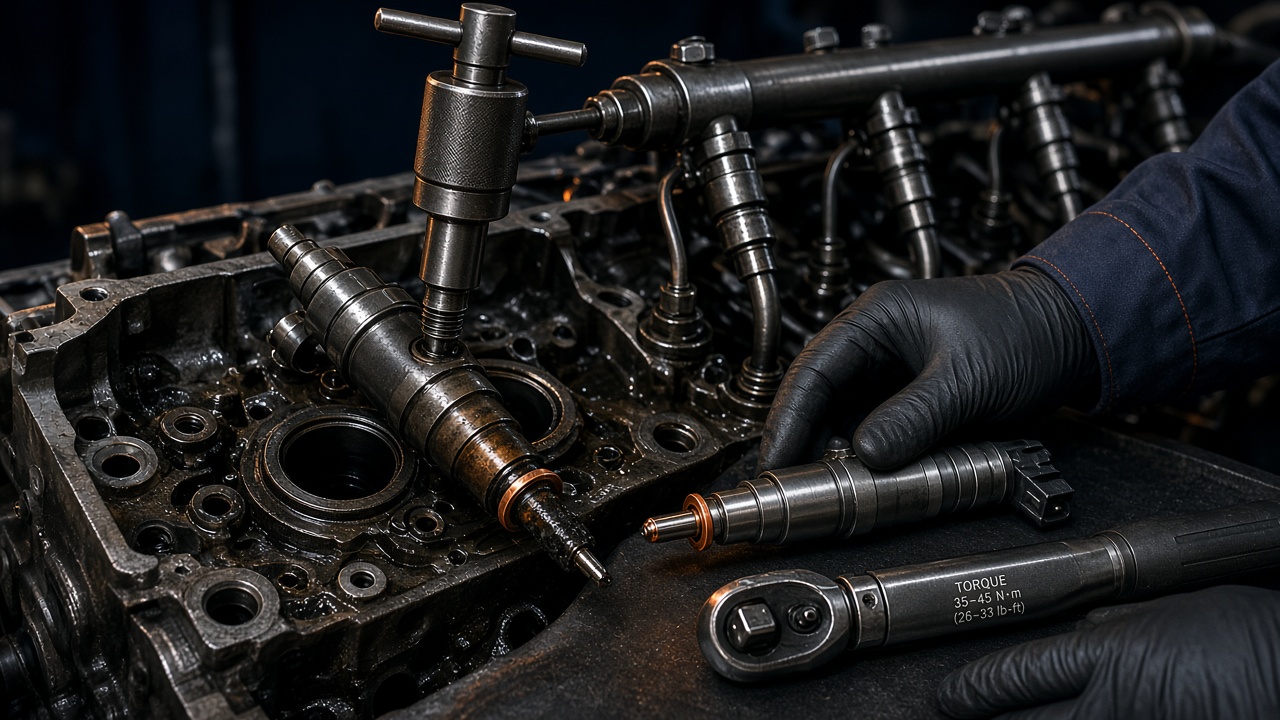
Replace Cummins X15 common-rail injectors in 8 steps: depressurize HP fuel system (remove pump fuse, crank 10 seconds), remove valve cover, disconnect electrical connector and fuel line, extract injector with puller tool (never pry on tip), install new copper seal, torque to 37 ft-lbs, code injector in INSITE (trim file from injector label), and verify rail pressure above 5,000 psi at idle. Budget 1.5–2 hours per injector; replace all six if fuel contamination is present.
Follow OEM service manual torque specs and one-time-use fastener requirements. High-pressure common-rail fuel and hot aftertreatment systems pose serious injury risk — use proper PPE and depressurization procedures before loosening any fuel or exhaust component.
Tools and Parts Required
INSITE for injector trim codes (X15), torque wrench ¼ drive (injector hold-down 37 Nm, line nuts per spec), injector puller slide hammer for stuck units.
New injector Cummins 4327070 series (verify ESN), copper cup washer mandatory every removal, new high-pressure line if disturbed (one-time use on some bulletins).
Fuel system cleaner caps — bag all open ports.
Safety: eye protection, fuel-resistant gloves, fire extinguisher — disconnect batteries before electrical disconnect on injector harness.
Depressurize High-Pressure Fuel System
Remove fuel pump fuse or run engine until stall after shutoff valve closed — CM2350: relieve via service procedure in QSOL Section 05.
Wait 10 minutes. Crack line nut at pump with rag — residual 5,000+ psi can spray.
Verify rail pressure zero on INSITE PID before loosening injector lines.
Removal Procedure
Remove valve cover, disconnect injector solenoid connector (pull straight — brittle clips).
Remove hold-down bolt and clamp. Extract injector with puller — do not pry on solenoid.
Inspect cup in head — carbon or erosion requires head service. Measure cup depth.
Plug hole immediately with clean rubber cap.
Installation and Torque
New copper washer seated dry. Injector square in bore — twist by hand until seated.
Hold-down torque: typically 37 Nm Cummins X15 — verify QSOL. Line nut torque: 30 Nm + 90° on some lines.
Route harness away from exhaust manifold — chafe causes misfire codes.
Injector Coding on X15
Each injector has trim code on body — enter in INSITE Service > Fuel System > Injector Trim.
Wrong code causes rough run, smoke, SPN 651/652 cylinder imbalance.
Replace all trim codes if full set changed.
Priming and Leak Check
Prime lift pump, crank with fuel rail vented until fuel at lines, torque lines to spec.
Key on — inspect for external leak 15 minutes before start.
First start: idle 5 minutes, no load. Check balance rates in INSITE.
Detroit DD15 Injector Differences
Detroit uses amplified common rail — different puller, hold-down torque 54 Nm on DD15 injector clamp.
DiagnosticLink injector codes required. One-piece unit — no separate cup on some builds.
Contamination Prevention
New fuel filters before start. Never open rail with dirty hands or air gun nearby.
Shop air filtered to 0.01 micron if blowing lines — prefer solvent flush only.
Labor Time and When to Replace Set
Single injector: 2.5–4 hours. Full set: 8–14 hours.
If one failed from contamination, replace all six and flush tank — partial set fails in 10,000 miles.
High-Pressure Fuel Injury Prevention
Common-rail fuel at 30,000+ psi penetrates skin — amputation risk. Never search for leak with bare hand — use cardboard.
Relieve pressure per OEM before any line loosening. Shop first aid kit and eyewash station required.
Train apprentices — most serious HD fuel injuries are on units thought “already depressurized.”
HP Fuel System Depressurization Detail
Remove fuel pump fuse or relay. Crank engine 10 seconds — rail pressure drops to zero. Wait 5 minutes for residual pressure bleed. Place rags around injector lines before disconnecting — residual pressure can spray fuel. Wear safety glasses. HP fuel penetrates skin — serious injection injury risk.
Injector Coding Procedure by Platform
Cummins X15: INSITE > Service > Fuel System > Injector Trim. Enter 6-digit trim code from injector label QR code. All 6 injectors coded even if replacing one — ECM needs complete set. Detroit DD15: DiagnosticLink > Fuel System > Injector Codes. Paccar MX: follow Cummins procedure on MX-13.
Post-Install Verification
Rail pressure at idle: above 5,000 psi (Cummins), 4,800+ psi (Detroit). No audible knock at idle. Road test: no white smoke, smooth acceleration. Re-scan at operating temperature — no SPN 157 (rail pressure low) or SPN 651 (cylinder imbalance).
OEM Interval Cross-Reference Table
Cummins X15: oil 25,000 mi/750 hr, fuel filters 25,000 mi/750 hr, valve lash 150,000 mi, DPF ash check 250,000–400,000 mi. Detroit DD15: oil 25,000 mi, valves 35,000 mi EPA17. Paccar MX: oil 20,000–25,000 mi. Always use whichever-comes-first rule.
Severe Duty Interval Adjustments
Short haul under 40 miles, idle above 30%, dusty conditions, or biodiesel B11+ cut standard intervals 30–50%. Hour-heavy vocational trucks (refuse, concrete) trigger PM on hours before miles. Telematics alert at 90% of interval prevents overdue service.
Parts Specification and Sourcing
Use API CK-4 15W-40 minimum for 2020+ low-ash requirements. Fleetguard, Donaldson, or OEM filters — verify application by engine serial. Counterfeit filters circulate on marketplace sites with incorrect micron rating.
Seasonal and Environmental Adjustments
Cold weather: winter fuel blend, pre-season filter change, DEF heater verification. Hot climate: shorten oil interval 15% in sustained 100°F+ ambient. High-altitude: monitor turbo boost and EGR function — derate calibrations differ above 5,000 feet.
Fleet PM Tracking Best Practices
Spreadsheet or CMMS tracking per unit: last service date, hours, miles, next due for each subsystem. Color-code overdue items. Monthly fleet meeting reviewing units exceeding average cost per mile by 2x.
Torque Specification Reference
Fuel filter: hand tight plus 3/4 turn per can instruction — over-torque crushes gasket causing air ingestion. Oil drain plug: 25–35 ft-lbs depending on pan material. Valve cover: 18 in-lbs in cross pattern. Always verify in OEM manual by engine serial.
Contamination Prevention Protocol
Cap all open fuel and oil ports immediately during service. Use clean rags and dedicated funnels. Never reuse crush washers on HP fuel fittings. Store filters in sealed packaging until installation — shop air contamination loads new filters before install.
Seasonal Service Adjustments
Pre-winter (September): fuel filters, battery test, block heater check, DEF heater verification, coolant concentration test. Pre-summer (April): A/C performance, cooling system pressure test, air filter inspection for pollen loading, tire pressure adjustment for heat expansion.
Fluid Specification Quick Reference
Engine oil: API CK-4 15W-40 minimum (Shell Rotella T6, Mobil Delvac Extreme, Valvoline Premium Blue). Coolant: ethylene glycol 50/50 to -34°F, test with refractometer annually. DEF: API certified ISO 22241, 32.5% urea, store below 86°F. Power steering and brake fluid per OEM spec on cab chassis.
Filter Part Number Cross-Reference
Cummins ISX15: oil LF14000NN (Fleetguard), fuel primary FS53000, fuel secondary FF5825, air AF25708. Detroit DD15: oil LF14000NN equivalent, fuel A0000904251. Cross-reference Donaldson, Wix, and Baldwin equivalents in Fleetguard catalog — verify micron rating matches OEM spec.
Pre-Service Inspection Checklist
Before any PM service: pull active fault codes, check fluid levels, inspect for leaks, note tire condition, verify last service date against interval. After service: road test 5 minutes, re-check levels, reset maintenance reminder in ECM if equipped, update fleet tracking spreadsheet.
Record Keeping for Warranty and Resale
Maintain service records per unit: date, hours, miles, parts installed with part numbers, technician name, and next due dates. Buyers and warranty auditors request complete maintenance history. Digital records in fleet CMMS preferred over paper — searchable by VIN and date range.
Fleet PM Cost Benchmarking
Track cost per mile for PM services across fleet. Industry benchmark: $0.08–$0.15/mile all-in PM for Class 8 linehaul. Vocational fleets (refuse, dump) run $0.12–$0.20/mile due to hour-heavy duty cycle. Units exceeding fleet average PM cost by 50% warrant individual review — may indicate abuse, wrong duty cycle classification, or mechanical problem increasing wear rate.
Compare OEM scheduled maintenance cost against actual shop invoices quarterly. Adjust intervals based on oil analysis results and operating conditions rather than blindly following generic schedule.
Fleet PM Cost Benchmarking
Used Oil Disposal and Environmental Compliance
Collect used oil in labeled containers — never mix with coolant, fuel, or DEF. Used oil recycler pickup every 90 days for shops generating over 55 gallons. Manifest required for transport. Oil filter crushing: drain filter 24 hours before disposal, crush to remove residual oil. Violations: EPA fines $25,000+ for improper disposal.
DEF waste (contaminated or expired) is not used oil — separate container, label hazardous. Small quantities may go to hazardous waste collection event. Bulk DEF spill: contain with absorbent, do not wash into storm drain.
Tool Calibration and Measurement Accuracy
Torque wrenches: calibrate annually or after 5,000 cycles. Pressure gauges: verify against known reference quarterly. Refractometer for DEF: zero with distilled water before each use. Multimeter: verify against known voltage source monthly. Inaccurate measurements cause misdiagnosis — wrong torque strips threads, wrong DEF reading condemns good fluid.
Heavy-Duty Diesel Technical Reference
Cummins Platform Quick Reference
ISX15/X15 CM2350/CM2450: oil 25,000 mi/750 hr, fuel filters 25,000 mi/750 hr, valve lash 150,000 mi, DPF ash check 250,000–400,000 mi. Key SPNs: 3251 (DPF soot), 4364 (SCR efficiency), 3216 (NOx sensor), 1569 (derate), 641 (VGT actuator). INSITE required for regen, inducement reset, and injector coding. INLINE 7 or Nexiq USB-Link 3 adapter.
Detroit Platform Quick Reference
DD13/DD15/DD16 EPA17: oil 25,000 mi, valve adjustment 35,000 mi, DPF soot in grams (70g regen threshold). Key SPNs: same J1939 mapping as Cummins. DiagnosticLink required for static regen and aftertreatment reset. DDDL adapter or Nexiq pass-thru.
Common Torque Specifications
DPF V-band clamp: 18–25 ft-lbs. NOx sensor: 35–45 Nm. Fuel filter: hand tight plus 3/4 turn. Oil drain plug: 25–35 ft-lbs. Injector hold-down (X15): 37 ft-lbs. Turbo actuator mounting: per Holset spec in service manual. Over-torque on exhaust clamps crushes flanges causing repeat leaks.
Aftertreatment Temperature Reference
DPF active regen: exhaust outlet 1,000–1,200°F. SCR operation: inlet 400–650°F. DOC light-off: 350°F minimum. NOx sensor ready: 650–800°F internal cell temperature. Do not work on exhaust components below 150°F touch temperature — still causes burns. Allow 45-minute cool-down after highway operation before under-vehicle work.
DEF Specification Summary
API certified ISO 22241. Concentration: 32.5% urea ±0.5%. Freeze point: 12°F. Shelf life: 12 months at 75°F. Test with refractometer — not color or smell alone. Contaminated DEF is the leading root cause of SPN 4364. Drain and flush tank if concentration below 30%. Replace inline filter after any contamination event.
Injector Puller Tool and Extraction Technique
Cummins injector puller 4919164 or equivalent — threads into injector body, applies upward force evenly. Never pry on injector tip or nozzle — damages bore. If injector stuck: soak with penetrating oil 24 hours, apply heat to bore area with heat gun (not direct flame on injector). Stuck injector in scored bore may require bore repair — inspect bore before installing new injector.
Frequently Asked Questions
Can I reuse the copper washer?
No. One-time crush seal — reuse causes combustion gas leak into fuel rail.
Do I need to code injectors on ISX15?
CM2350 older may not require trim entry; X15 CM2450+ requires coding every replacement.
What torque for injector lines?
Follow QSOL for your line type — over-torque cracks fitting, under-torque leaks high-pressure fuel.
Why did my new injector fail in a week?
Contamination, wrong trim code, or damaged cup seat — always inspect cup and change filters.
Is injector replacement DIY feasible?
Only with proper tools, INSITE, and high-pressure fuel safety training — otherwise shop.
Related tools: Use our injector replacement cost for quick estimates and planning.
Related reading: diesel injector replacement cost breakdown, fuel filter service intervals, diagnose runaway diesel engine.
Sources
- Cummins QSOL injector R&R procedures
- Detroit DD15 fuel system service manual
- Bosch common-rail injector specifications
Related Reading
- diesel injector replacement cost breakdown
- fuel filter service intervals
- diagnose runaway diesel engine.
Verification Checklist Before Closing the Job
Photograph failed parts, log all meter and scan-tool readings on the work order, and retain freeze-frame data. Fleet and warranty audits reject claims without documented root-cause proof. Compare your readings to OEM service information for the specific engine serial number — mid-year calibration updates change test limits without changing the fault code definition.